
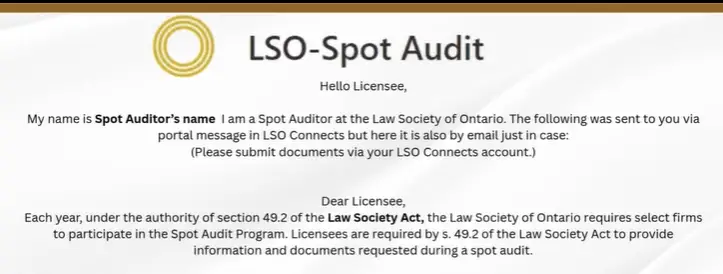
Heart rate spikes. Files flash through your mind: trust ledgers, bank statements, that one old client ledger with a lingering balance. Is everything current? Did you miss a reconciliation? You're not alone—every Ontario lawyer faces this eventually.
The reality: The LSO audits every licensee roughly every 3-5 years (new firms often in year one). Notice typically gives you 2-3 weeks to prepare—not the 30 days many assume—so panic is normal, but preventable. The #1 failure point? Trust accounting. Mixing funds, late reconciliations, incomplete ledgers—these trigger most citations and can escalate to serious issues if uncorrected.
As a solo or small firm, you juggle everything: client work, billing, admin. Trust compliance often slips to the bottom until that notice arrives. But with structured prep—and smart use of practice management software—you turn audit dread into a routine compliance check. ClearPoint sees this weekly—solos who prep smartly (and leverage tools like Clio or CosmoLex for automated ledgers and reports) sail through with minor notes (or none), while the unprepared face follow-ups, reports to LSO Connects, or worse.
Start by reviewing the LSO's official Spot Audit page and their Bookkeeping Guide—the main resource for audits and By-Law 9 compliance.
This guide gives you the facts, the common traps, and a proven 5-step prep plan to get audit-ready fast—even if you're starting from behind.
If you need help, ClearPoint Legal Consulting can assist with pre-audit evaluation and clean-up. If you want to know exactly where you stand before an audit arrives, our LSO Audit Preparedness Review is a fixed-fee engagement that covers your trust accounting, records, and internal controls and delivers a written findings report — don't hesitate to reach out.
LSO Spot Audit Facts: What You Need to Know
Spot audits enforce By-Law 9—the bible for financial record-keeping, especially trust accounts. (Full text: By-Law 9.) The LSO's goal: proactive compliance, not punishment. Audits measure integrity of financial filings (By-Law 8), ongoing adherence to By-Law 9 (trust/general records), and Rules of Professional Conduct around money-handling.
Frequency & Selection
- Cyclical: Most firms every 3-5 years; new solos/firms often audited within 12 months.
- Risk-based now: Using up to 10 years of data, LSO targets higher-risk profiles—solos with real estate/estates/POA work, overdrawn accounts, dormant ledgers, or prior issues. Random elements remain, but data drives many selections.
Scope & Process
- Focus: Primarily trust accounts (reconciliations, ledgers, comparisons), plus general books if flagged.
- Format: Remote (most common for low-risk), onsite (higher-risk or complex), or hybrid. ~25% onsite per recent updates; auditors provide guidance to fix minor issues on the spot.
- Timeline: 2-3 weeks notice usually; submit docs via LSO Connects or in-person. Auditor reviews records, discusses deficiencies, issues Audit Report with findings/recommendations. Follow-ups possible if issues persist.
Common Citations (The Big Ones to Avoid)
Trust accounting dominates failures—here's what auditors flag most:
- Incomplete or late monthly reconciliations — Must complete by the 25th of the following month (bank statement + detailed trust reconciliation + client trust listing + comparison). Unexplained differences = red flag.
- Mixed funds / commingling — Client trust money in general account, or vice versa; keeping earned fees in trust too long (beyond reasonable time).
- Dormant/inactive ledgers — Old balances with no activity; unclaimed funds not handled properly.
- Poor record-keeping — Missing journals (trust receipts/disbursements), no valuable property record, incomplete client ledgers (must be separate per client). See the LSO's Summary of By-Law 9 Record Keeping Requirements for a clear overview.
- Overdrafts/outstanding deposits — Trust shortages or uncleared items not addressed promptly.
These aren't rare—many stem from solo overload. But they're fixable with discipline—and modern tools that automate much of the tracking.
The 5-Step Prep Plan: Get Audit-Ready in Weeks
Don't wait for the envelope. Implement this plan annually (or immediately if notice arrives). Many Ontario solos and small firms use legal-specific practice management and trust accounting software (systems like Clio or CosmoLex) to make this far easier—automatically saving ledgers, generating reconciliation reports, and compiling documentation in exportable formats for auditors.
Step 1: Gather & Organize Core Records (Days 1-3)
Round up everything By-Law 9 requires (retain 10 years for trust records):
- Trust & general bank statements (last 2-3 years minimum).
- Duplicate receipts/deposit slips, cashed cheques.
- Trust receipts & disbursements journal.
- Client trust ledgers (separate per client/matter).
- Monthly trust comparisons/reconciliations.
- Valuable property record (wills, deeds, etc.).
Step 2: Run Full Monthly Trust Reconciliations (Days 4-7)
The #1 citation trigger. Do three-way reconciliation for every trust account:
- Bank statement balance.
- Adjusted book balance (outstanding cheques/deposits).
- Client trust listing total (sum of all client ledgers).
Must match exactly. Explain differences. Complete for last 12 months (or more if requested). Fix shortages instantly—deposit personal funds if needed, then reimburse. Review for dormant balances; contact clients or prepare for Unclaimed Trust Fund if >2 years inactive.
Step 3: Audit Your Ledgers & Journals (Days 8-10)
Scrutinize:
- Every client ledger current? No negative balances unless explained.
- No mixed funds? Transfer earned fees out promptly.
- Journals posted accurately (date, amount, source, purpose, method)?
- Receipts/disbursements match bank records?
Use checklists from LSO resources (e.g., the reconciliation tips above or the Bookkeeping Guide). Correct errors, post adjustments, re-reconcile.
Software shines here too—built-in safeguards prevent common errors like commingling, and per-client ledgers stay separate and up-to-date automatically.
Step 4: Prepare Documentation Package & Self-Review (Days 11-14)
Compile:
- Most recent trust comparison (within 25 days of month-end).
- Sample ledgers (high-activity clients).
- Explanations for any unusual items.
- Proof of corrections (if prior issues).
Self-audit: Pretend you're the LSO auditor. Check for red flags like stale cheques, unexplained variances, or commingling. Document fixes—shows good faith.
With systems like Clio or CosmoLex, this step is streamlined—pull pre-saved reconciliation docs, ledger exports, and transaction histories in one place, often with timestamps for easy proof of compliance.
Step 5: Plan for the Audit Day & Follow-Up (Ongoing)
- Remote: Upload via LSO Connects; have video/call ready.
- Onsite: Clear space, have staff (if any) prepped; auditors bring ID.
- During: Be transparent—ask questions, take notes on recommendations.
- After: Implement fixes promptly; submit proof if required. Most minor issues resolve here—no discipline if addressed.
Many solos and small firms rely on these tools year-round to avoid the scramble entirely.
Final Thoughts: Turn Audit Fear into Confidence
Spot audits feel scary, but they're remedial—designed to catch issues early and guide fixes (as outlined on the LSO Spot Audit page). Firms who stay on top of By-Law 9 (monthly habits, not annual cramming) breeze through. The payoff: clean books, client protection, peace of mind.
Investing in practice management software with strong trust features (like Clio or CosmoLex) pays off hugely—automating reconciliations, saving documents, and providing compliant reports makes monthly compliance routine and audit prep straightforward.
If this notice just arrived or you're due soon, start the 5-step plan today — cross-check with the LSO's Bookkeeping Guide for full details. Need hands-on help? ClearPoint specializes in LSO compliance for Ontario lawyers — trust setup, audit prep, and software optimization. Learn more about our LSO Audit Preparedness Review or book a call to discuss your situation directly.
You're not alone in this. Stay compliant, stay confident.