
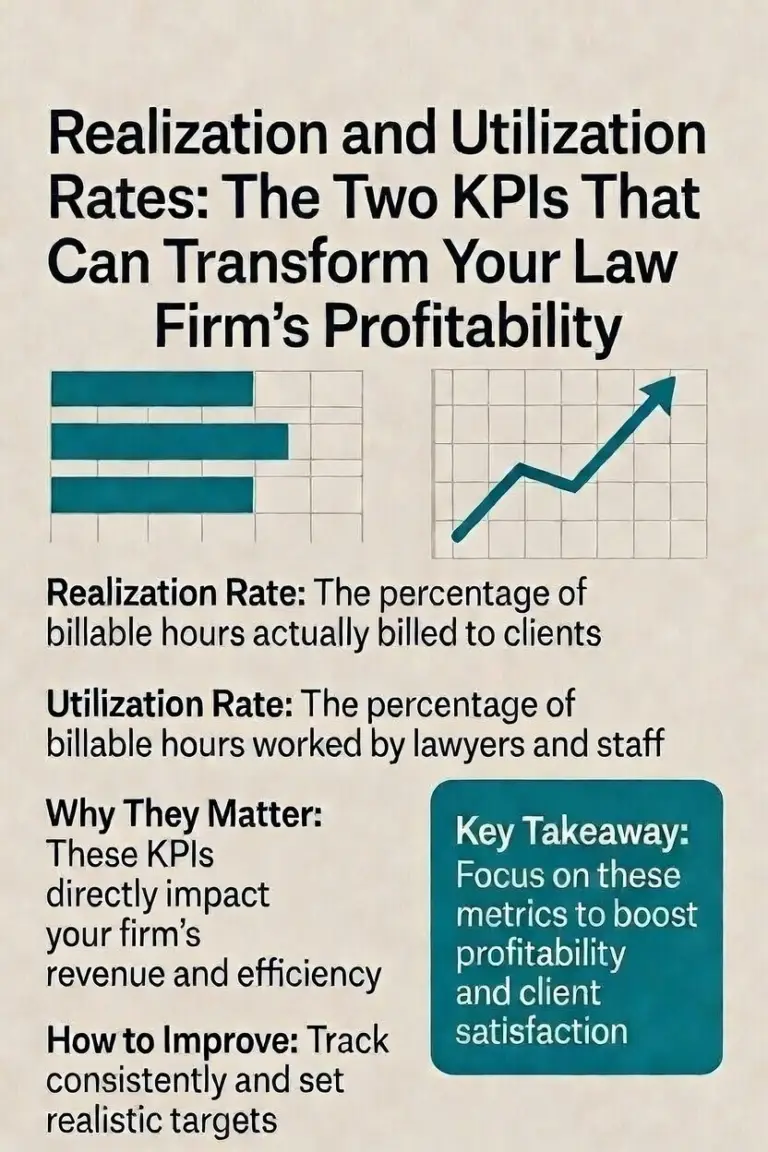
Essential metrics, 2025 benchmarks, and practical steps for small and mid-sized Canadian law firms
Introduction
Tracking billable hours is table stakes for any law firm. But to truly gauge efficiency, profitability, and where leaks are draining revenue, you need to look at two interconnected metrics: utilization rate and realization rate.
These aren't just abstract numbers. Law firm realization & utilization rates reveal how effectively your team converts time and effort into actual cash flow. For small and mid-sized firms operating with lean teams and tight margins, mastering these KPIs can unlock significant revenue gains without hiring more lawyers or working longer hours.
In this guide, we'll define each metric, explain why they matter, share current industry benchmarks, and provide actionable strategies to improve them.
Why These Metrics Are Non-Negotiable for Modern Law Firms
- Reveal exactly where time is leaking (admin, meetings, poor tracking)
- Highlight why billable effort isn't turning into collected revenue
- Guide smarter decisions on staffing, pricing, delegation, and client selection
Firms that monitor and act on these numbers consistently outperform peers—often by 10-20% in effective revenue per lawyer.
Utilization Rate: How Much of Your Time Is Actually Billable?
Utilization rate measures the percentage of a team member's total available working hours spent on billable client work.
Utilization Rate = (Billable Hours ÷ Total Available Hours) × 100
Example: A lawyer works 40 hours in a week (excluding vacation/sick time) and logs 28 billable hours:
(28 ÷ 40) × 100 = 70%
Current Benchmarks (2025 data from Clio Legal Trends Report):
- Industry average: ~38% (about 3 billable hours in an 8-hour day)
- Strong performers: 65-75%+
- Top small/mid-sized firms often target 40-45% as realistic and sustainable
Low utilization usually signals too much non-billable work (admin, marketing, internal meetings), inconsistent time tracking, or under-delegation.
Realization Rate: How Much Billed Work Actually Becomes Revenue?
Realization rate shows how effectively billable time converts to paid invoices. It comes in two flavors:
- Billing Realization — Time entered vs. time actually billed (after write-downs/discounts)
- Collection Realization — Billed amount vs. amount collected
Most firms focus on overall realization (collected ÷ worked value).
Realization Rate = (Amount Collected ÷ Value of Time Entered at Standard Rates) × 100
Example: Your team enters $15,000 in billable time at standard rates, bills $13,500 after write-downs, and collects $12,000:
Overall realization ≈ 80% (with billing at 90% and collection at ~89%).
Current Benchmarks (2025 data):
Industry average: ~88%
Healthy target: 90%+
Top firms: 93-95%+ (especially in transactional/IP practices) [source]
Common culprits for low realization: vague time entries, scope creep, aggressive discounts, slow invoicing, or difficult clients who habitually dispute bills.
Proven Strategies to Boost Utilization
- Delegate ruthlessly — Shift admin, document prep, research, and basic filings to paralegals or virtual assistants. Lawyers billing at $300+/hr shouldn't scan documents.
- Promote real-time time entry — Use mobile apps to capture time immediately; delayed entries lead to 10-20% under-recording.
- Set role-specific targets — Partners might aim for 60-70%, associates 75-85%, support staff lower. One-size-fits-all goals demotivate.
- Leverage task and project tools — Built-in features in practice management software help prioritize billable work and reduce context-switching.
Proven Strategies to Boost Realization
- Invoice promptly and clearly — Send detailed, plain-language bills within days of month-end. Clarity reduces disputes and speeds payment.
- Train on descriptive time entries — Require narratives that justify value (e.g., "Drafted motion to dismiss, analyzing 4 key precedents") instead of "Research."
- Embrace alternative fee arrangements — Flat fees, capped fees, or hybrid models set expectations upfront and minimize write-downs.
- Conduct regular client profitability reviews — Identify chronic low-realization clients and either renegotiate terms or phase them out.
Tools to Make Tracking Effortless
Purpose-built legal practice management solutions excel at accurate time entry, automated reporting, and dashboards for utilization and realization—far better than generic tools.
- Clio — A top choice for small and mid-sized firms; robust time tracking, mobile entry, customizable reports, and built-in realization/utilization insights.
- CosmoLex — Strong all-in-one option with excellent billing workflows, trust accounting integration, and clear KPI tracking.
- Other purpose-built practice management solutions — Look for lawyer-specific platforms (e.g., those with native time-capture apps, AI-assisted entry, and profitability analytics) that automate the heavy lifting.
As a Clio Certified Partner, ClearPoint Legal Consulting specializes in helping Canadian firms (especially solos and small teams) implement and optimize these systems for maximum efficiency. ClearPoint offers a free operations audit—a no-obligation 30–60 minute review of your workflows, tools, and bottlenecks, delivering a prioritized action plan to boost utilization, realization, and overall profitability. It's a great low-risk way to get expert eyes on your setup.
Quick-Start Plan: Measure for One Month
- Pick 2-3 key timekeepers (or the whole firm).
- Track weekly: total hours, billable hours entered, billed amount, collected amount (use your practice management software's reports).
- Calculate utilization and realization.
- Hold a short team huddle: What surprised you? Where can we improve? Consider booking a free audit with a specialist like ClearPoint if you want external insights to accelerate progress.
Small, consistent tweaks compound—many firms see 5-10% revenue lift in the first quarter.
Final Thoughts
Law firm realization & utilization rates aren't vanity metrics; they're diagnostic signals showing how well your firm turns lawyer effort into sustainable profit. In an era of rising costs and client pressure on fees, firms that ignore these numbers risk stagnation—while those that track, optimize, and get expert help build stronger, more resilient practices.
Start measuring today. The data will tell you exactly where the biggest opportunities lie. Your bottom line (and your team) will thank you.