The LSO Wants Firms to Succeed. The Process Is Manageable. But Best If You Already Know What They Are Going to Find.
Trust accounting sits at an uncomfortable intersection for most Ontario lawyers. It is not what you studied, it is not what you spend your days on, and it is not where your confidence naturally lives.
The volume of client work makes it easy for compliance habits to drift without anyone noticing, and most lawyers are too busy running their practice to step back and verify that everything is actually in order.
The lawyers I talk to are not careless about this. Most of them have read the rules. They know reconciliations need to happen monthly. They know commingling is serious. They have a bookkeeper or accountant handling the day-to-day, and on the surface things appear to be running. The honest concern is that "appears to be running" and "would hold up to an audit" are not always the same thing, and without a deliberate review, most lawyers have no reliable way to know the difference.
Worth saying clearly: the LSO is not approaching this process looking for a reason to act against you. Their own materials describe spot audits as a proactive compliance tool, and a primary goal is to provide guidance that helps firms correct minor deficiencies before they become serious problems. For firms with clean records, that is genuinely how the process plays out.
The challenge is that the audit is designed to find out where you stand, not to give you time to figure it out first.
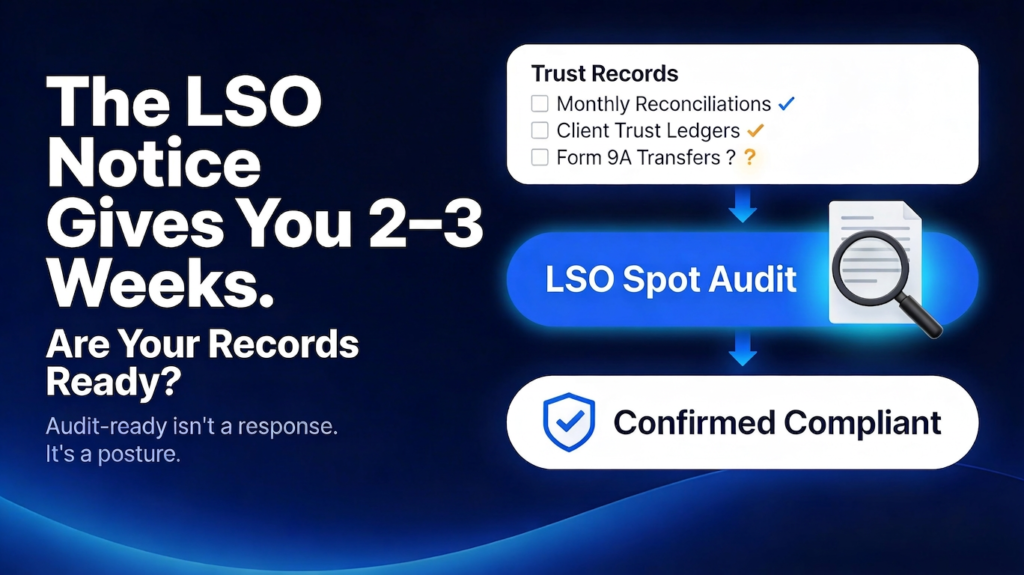
The LSO audits every Ontario firm on a recurring basis, typically every three to five years, and new firms are generally selected within their first twelve to twenty-four months of practice. For most lawyers, the notice is not a question of if, but when.When the LSO notifies a firm that it has been selected for a spot audit, there is a window — typically two to three weeks — to organize and submit the required records. That window is best used for producing what you already have in order, not for discovering gaps you were unaware of and working out how to address them before the submission deadline.There are patterns that come up consistently in Ontario solo and small firm practices, not because lawyers are careless, but because the volume of client work makes it easy for certain things to drift.
Dormant trust balances are one of the most common. A client goes quiet. The matter closes informally. The balance sits unreviewed for months, then a year. By-Law 9 has specific requirements around how funds in inactive accounts are handled, and an auditor will look at them. The issue is not always that something wrong was done. Sometimes it is that nothing was done, and inaction on a trust balance has its own compliance implications.
Form 9A compliance is another area that gets missed more often than people expect. Under section 12 of By-Law 9, every electronic transfer from trust to general requires a completed electronic trust transfer requisition in Form 9A, signed before the transfer is made and retained alongside a signed printed confirmation afterward. In busy practices this discrete step does not always happen consistently for every applicable transaction. An auditor will ask to see these records.
Being prepared to explain it clearly is different from assuming the correction speaks for itself in the records.
Then there are the situations that feel resolved but carry residual risk. An accountant catches a discrepancy and corrects it. The books balance. Life moves on. But historical records that show an irregularity without clear documentation of how it was addressed can create questions that require explanation.
For a solo or small firm lawyer, the stakes of going into an audit uncertain about your records are real. A finding that requires follow-up is a distraction from client work at minimum. Repeated or serious findings can lead to re-audits and, in some circumstances, cost recovery applications by the LSO. None of that is the likely outcome for a firm with basically sound practices. But "basically sound" and "confirmed compliant" are different things, and most lawyers who think they are probably fine have simply never had a reason to verify it.
That quiet uncertainty is worth paying attention to. Not because the LSO is coming after anyone, but because knowing where you actually stand is a reasonable thing to want, and the right time to find out is before someone else is looking at the same records and drawing their own conclusions.
Audit-ready isn't a response. It's a posture.
A structured review before an audit covers the same ground an auditor would, but in a context where findings lead to fixes rather than formal reports. That means looking at whether monthly reconciliations are complete and on time, whether client trust ledgers are maintained correctly per matter, whether Form 9As are being generated and retained for every applicable electronic transfer, whether dormant accounts have been reviewed and handled appropriately, and whether the firm's records could be produced promptly and completely if requested.
For firms running CosmoLex or Clio, most of this information is already in the system. The question is whether it has been set up and maintained in a way that reflects By-Law 9 requirements, and whether the reports an auditor would want to see can be generated cleanly. Having the software and having it configured correctly are not the same thing.
Most lawyers who would benefit from a pre-audit review are the ones who think they are probably fine and have a quiet uncertainty about whether "probably" is good enough. That uncertainty is worth resolving, and doing it proactively is straightforward.
But some lawyers already know there are issues. A reconciliation that has not been done in months. A trust balance sitting longer than it should. A process that has been inconsistent. If that is the situation, the conversation starts in a different place but it is not a dead end. The audit preparedness review identifies what exists and maps the gaps. From there, the work of addressing known issues is a separate engagement ClearPoint handles regularly. The starting point is just different, not the outcome.
Either way, the right time to have that conversation is before the LSO notice arrives.
ClearPoint's LSO Audit Preparedness Review is a fixed-fee engagement for Ontario solo and small firms. We review your trust accounting, records, and internal controls against By-Law 9 requirements and deliver a written report of findings and prioritized recommendations before an auditor does the same thing.
Learn more about the review