

LSO Practice Review Preparedness · Ontario Solo & Small Law Firms
The reviewer is coming. Let's make sure you're ready.
An LSO practice review is a full-day examination of how you actually run your practice — your files, your systems, your client communications, your retainer agreements. ClearPoint helps Ontario lawyers get their practice ready before the reviewer arrives, or implement the LSO's recommendations after the report lands.
Who This Is For
Two situations. One service.
Most lawyers who contact ClearPoint about a practice review fall into one of two situations. Both are common. Both are fixable.
You received the notice and the review hasn't happened yet
You want to know where your practice stands and get any gaps fixed before the reviewer arrives. ClearPoint reviews your current systems and documents against the same criteria the LSO will use, and puts the right things in place before review day.
You have the LSO report and need to implement the recommendations
The review is done. The LSO has told you what needs to change, and you have a follow-up review timeline to meet. ClearPoint works directly from your report to implement the recommendations and get the documentation in place.
If you're an associate — or a firm principal whose associate received a notice
Associates can be selected for a practice review even when they have limited control over firm-wide systems. The LSO is clear on this: where deficiencies relate to systems managed by firm leadership, those findings are escalated directly to firm management. If you're an associate navigating this situation, or a principal who needs to get ahead of that conversation, ClearPoint can help both of you understand what's at stake and what needs to change.
What the LSO Examines
More detail than most lawyers expect.
One thing that catches lawyers off guard is the level of specificity involved. This is not a general conversation about how you run your practice. The reviewer will walk through actual client files, ask to see your conflicts database, review your retainer agreements, and examine how you document client communications. They will want specifics — not a description of your process, but evidence of it.
The six areas the reviewer will assess are:
Retainer terms, managing expectations, documenting advice, reporting letters, response practices
Opening and closing procedures, conflicts checking, non-engagement letters, file naming, storage
Tickler and bring-forward systems, limitation period tracking, key date monitoring
Docketing practices, fee disclosure, proportionality of interim invoices, account statements
Entry-level competencies in areas practised, approach to unfamiliar practice areas
Data protection, backup procedures, password practices, cybersecurity incident response
How It Works
Straightforward from first call to finished.
The process is designed to be efficient for a lawyer who is already managing a busy practice alongside a regulatory timeline.
Free intake call — 30 minutes
We talk through your situation — when the review is scheduled, what your practice looks like, and what you already have in place. If you have the LSO report, we use that as the starting point. At the end of the call you'll have a clear picture of what the engagement involves and what it will cost before you commit to anything.
Document review and gap assessment
You share your current retainer agreement, any existing office procedures, and whatever else is relevant to your practice. ClearPoint reviews everything against the LSO's review criteria and identifies what's present, what's incomplete, and what's missing entirely.
Remediation — templates, procedures, and implementation
ClearPoint puts the right things in place. That means updated retainer agreements, a documented conflicts process, a Practice Memorandum, communication protocols, and whatever else your practice needs. Everything is customized to your firm and practice-ready — not generic templates you have to figure out how to adapt.
Ready for review day
You go into the review with the documentation in place and a clear understanding of your own systems. The LSO's intent is remedial — they want to see that you're running a sound practice. Walking in prepared makes that a very different experience than walking in hoping for the best.
What Gets Fixed
The gaps that come up most often.
Every practice is different, but certain deficiencies appear consistently across solo and small firm practice reviews. These are the areas where most lawyers have either nothing in place or something that falls short of what the reviewer will expect to see.
Retainer and engagement lettersScope of services, termination terms, billing basis, interest, Solicitors Act rights, communication consent — built to the full LSO checklist
Conflicts management systemA searchable database with the right fields, a documented search procedure covering all four trigger points, and a search log format
Non-engagement lettersFor prospective clients who consult and are not retained — one of the most commonly missing documents in small firm practices
Client communication protocolsA written standard for documenting calls and meetings, confirming advice, and sending reporting and closing letters
Practice MemorandumThe written contingency document the LSO expects sole practitioners to have — covering coverage arrangements, file access, key dates, and succession
File management proceduresConsistent file opening and closing protocols, naming conventions, retention policy, and storage practices
Client ID and verification processDocumented procedure and the correct forms for individuals and organizations, including a monitoring record
Incident response planA written cybersecurity response procedure covering the scenarios the LSO specifically expects lawyers to have planned for
Not sure where your practice stands?
Start with a free 30-minute intake call. We'll talk through your situation, identify what's likely to need attention, and give you a clear picture of what the engagement involves before you commit to anything.
Practical Insights

You’ve Been Selected For An LSO Practice Review – Now What?
What Ontario Lawyers Need to Know When an LSO Practice Review Notice Arrives A practice review notice from the Law Society of Ontario is not a complaint and it is not an investigation. But it is not something you want to walk into unprepared. The level of scrutiny involved is
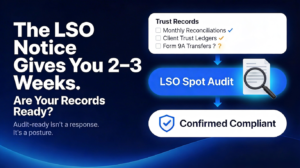
The LSO Wants Firms to Succeed – Are You Ready For A Spot Audit?
The LSO Wants Firms to Succeed. The Process Is Manageable. But Best If You Already Know What They Are Going to Find. Trust accounting sits at an uncomfortable intersection for most Ontario lawyers. It is not what you studied, it is not what you spend your days on, and it
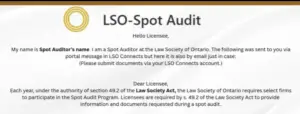
LSO Spot Audits: 5-Step Prep Plan for Ontario Solos & Small Firms
Heart rate spikes. Files flash through your mind: trust ledgers, bank statements, that one old client ledger with a lingering balance. Is everything current? Did you miss a reconciliation? You’re not alone—every Ontario lawyer faces this eventually. The reality: The LSO audits every licensee roughly every 3-5 years (new firms