

Why Your Best Law Firm Growth Ideas Keep Getting Buried — And a Simple Way To Make Them Stick
Picture this: You wrap up a productive weekend or come back energized from a CLE. Ideas pour in — maybe tweaking your intake process to save an hour a week, testing flat-fee packages for routine matters, reaching out to past clients for referrals, raising rates in one practice area, or finally evaluating whether switching to or optimizing Clio (or another tool) makes sense.
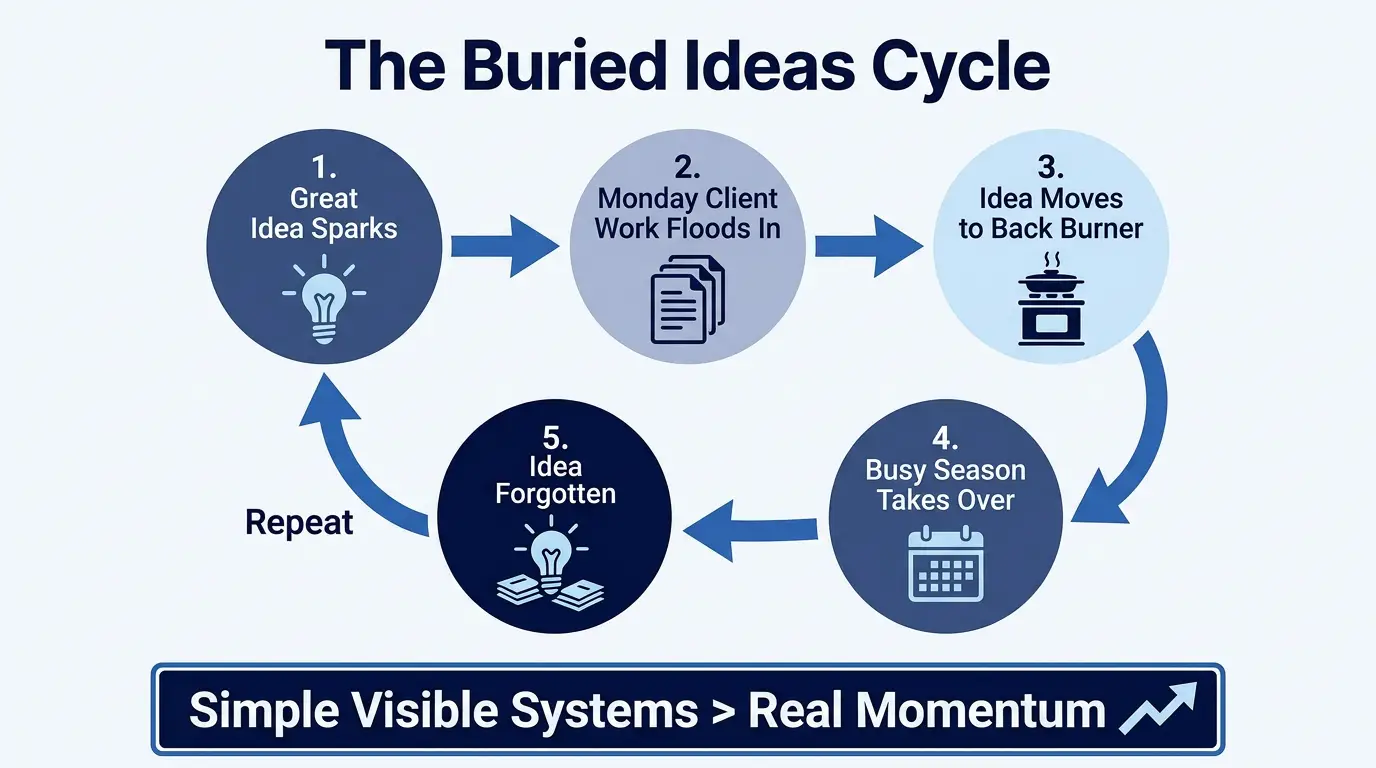
You jot a few notes, feeling motivated. Then Monday morning hits. The inbox explodes, a filing deadline looms, a client calls with an urgent issue, and suddenly those promising ideas are pushed to the side. By the end of the week — or the month — they’ve quietly disappeared, buried under the weight of billable work and daily admin.
If you’re a solo practitioner or part of a very small firm (maybe one or two other lawyers and little to no support staff), this cycle is painfully familiar. You’re not lazy or undisciplined. You’re running a lean business where client demands always feel more immediate and more important than long-term strategy. The result? Great ideas stay just that — ideas — while your practice stays exactly where it is.
Why Great Ideas Die So Easily in Solo and Small Law Firms
It’s rarely a lack of vision. It’s the reality of wearing every hat: lawyer, marketer, bookkeeper, receptionist, and strategist. Here’s what typically happens:
- Client work always feels more urgent — and it pays today’s bills.
- With little or no admin support, every strategic task competes directly with returning calls, drafting documents, billing, and basic office operations.
- Ideas live scattered — in notebook margins, phone voice memos, sticky notes, or half-written emails — so they vanish the moment your attention shifts.
- Even modest changes feel overwhelming. Overhauling intake forms, building a simple marketing habit, or adopting new software can seem like a massive project when your calendar is already full.
You might already monitor key numbers like realization and utilization rates. But linking those metrics to bigger growth initiatives is hard when you’re constantly firefighting.
The Real Cost of Letting Ideas Slip Away
Over time, this pattern has a compounding effect:
- Revenue growth stalls while overhead continues to rise.
- You stay trapped in reactive mode, always working hard but rarely working on the business.
- Burnout builds because the feeling of constant busyness without forward progress is exhausting.
- Other small firms that manage to implement even a few changes slowly pull ahead in profitability, work-life balance, or client mix.
The encouraging news? You don’t need more hours in the day, a full-time administrator, or a big-firm infrastructure. You need a lightweight, repeatable system that captures ideas, turns them into tiny doable steps, and keeps them visible — without creating extra work.
A Practical Framework Designed for Solos and Small Teams
Here’s a five-step approach that fits around real client demands. It’s intentionally simple so you can start using it this week.
1. Capture every idea in one dedicated spot
Choose a single home — a Google Doc, a dedicated notebook section, or a simple digital folder. The goal is to stop ideas from living in ten different places.
2. Immediately break the big idea into one ridiculously small next action
This is the game-changer. Instead of “Build a better referral system,” write “Spend 25 minutes drafting one LinkedIn post for past clients.” Small wins create momentum.
3. Protect a tiny, consistent block of non-billable time
Many solo owners block just 45–60 minutes once a week (Friday morning works well for many) and treat it like a non-negotiable client appointment. Put it in your calendar and guard it.
4. Make progress visible with a quick weekly review
Spend 10 minutes at the end of your protected block scanning what moved forward. No long reports — just a quick glance so nothing falls through the cracks.
5. Connect the idea to your actual numbers
Ask: How does this link to realization rate, utilization, cash flow, or hours back in your week? When the effort feels tied to real results, it’s easier to prioritize.
| Big Idea | One Small Next Action | Owner | Due Date | Status |
|---|---|---|---|---|
| Improve client intake process | Research 2–3 intake form tools or templates | You | This Friday | In progress |
| Boost referrals from past clients | Draft one short LinkedIn or email message | You | Next Wednesday | Not started |
| Explore flat-fee options in family law matters | Review 2 articles or Clio resources on alternative billing | You | End of this month | Not started |
| Raise rates in estate planning | Calculate current realization rate on similar matters | You | Next Monday | Done |

Common Pitfalls (and Easy Fixes)
Even with good intentions, a few traps show up repeatedly for solos:
- Perfectionism — Fix: Aim for “good enough” on the first small step.
- Overloading the list — Fix: Limit yourself to 3–5 active ideas at any time.
- Losing visibility during busy periods — Fix: Use a tool that sends gentle reminders and shows everything in one screen.
Your Quick-Start Action Plan for This Week
- Pick just one idea that’s been sitting on the back burner.
- Write down one tiny next action (no more than 30–60 minutes of effort).
- Block that time on your calendar this week and protect it like a client meeting.
- At the end of the week, spend 10 minutes noting what happened and what comes next.
Download Your Free Buried Ideas Tracker Template
Ready to stop letting great ideas get buried under client work? Enter your email and I’ll instantly send you the Excel template.
Instant download link sent to your email
Final Thoughts
You already have the vision and the drive — what’s often missing is a simple structure that gives your best ideas a fighting chance against the daily whirlwind. Small, consistent steps tracked visibly really do compound. Over months, those tiny actions can lead to more predictable revenue, better client experiences, and even some breathing room in your schedule.
If you’ve felt the frustration of watching good ideas fade away, start with just one this week. You’ve got this. The practice you want is built one protected hour and one small action at a time.